

Trades and store credit
Manage intake, pricing, approval, payouts, and the ledger behind each customer balance.
Cardstead gives your team one place to manage trades, store credit, money, calendars, employees, and the records that keep every location moving, across the counter or across town.
Every balance change, payout, and approval stays in the record so the next employee picks up where the last left off.
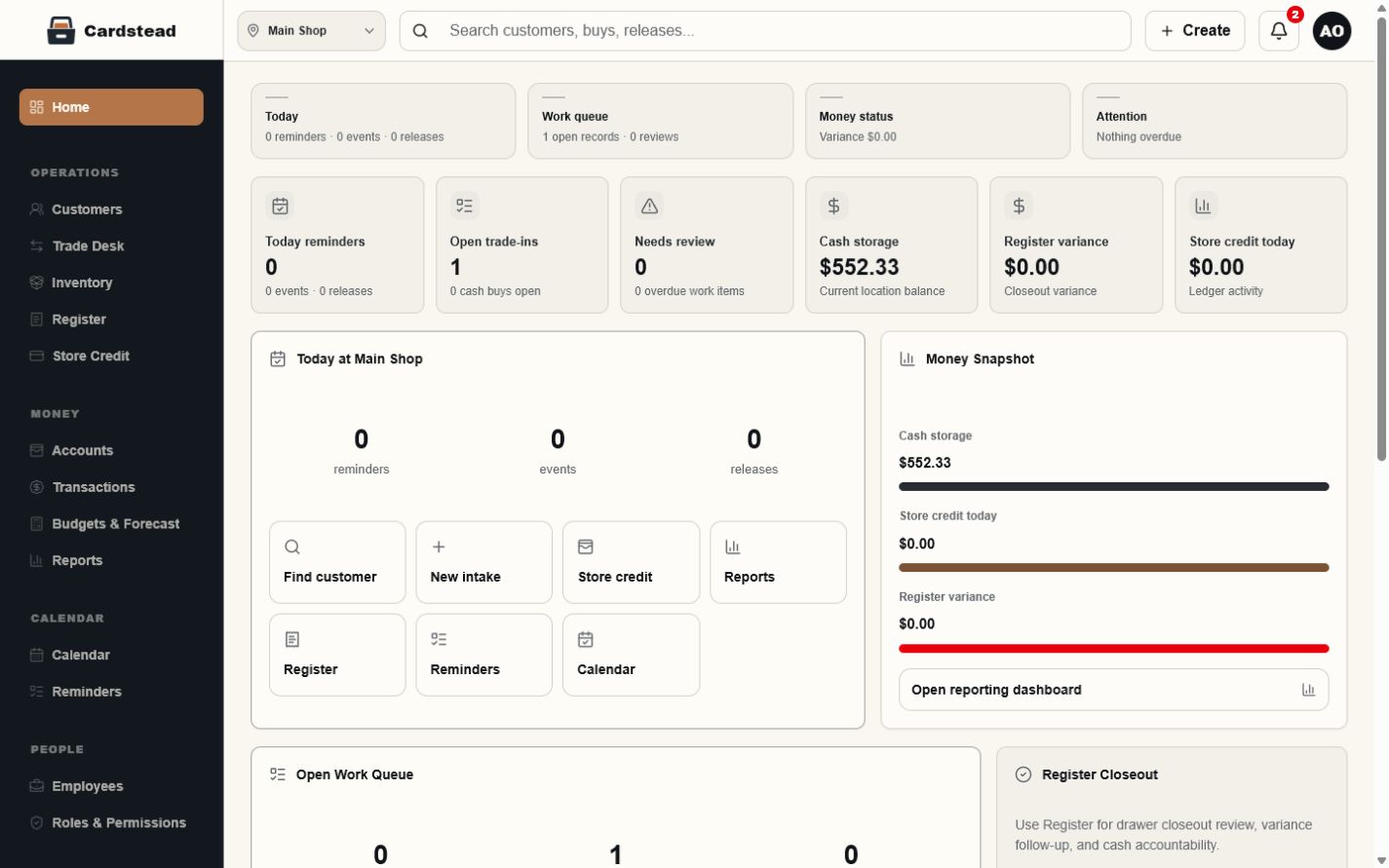
Manage intake, pricing, approval, payouts, and the ledger behind each customer balance.
Track accounts, register sessions, safe activity, cash movement, budgets, and reports.
Plan releases, events, preorder dates, customer calls, and employee follow-up.
Manage employees, roles, locations, permissions, and the history behind important actions.
Cardstead keeps the record behind each balance, payout, approval, and correction so the next employee can pick up where the last one left off.
See how the workflows fit togetherWhich trades are still waiting for review or a customer decision?
Why did this customer’s store-credit balance change?
Who approved this cash payout, and where did the money come from?
What changed between the expected drawer and the final count?
Accounts, locations, and permissions keep each person in the right part of the shop. Important changes stay in the record for owners and managers to review.
Read about security and customer dataA condition-review process with inspection notes, pricing math, escalation triggers, and a record both buyer and customer can follow.
Read guideA worked Friday-night closeout that separates cash sales, entry fees, trade payouts, paid-outs, transfers, and physical count.
Read guideA worked ledger timeline for finding unsupported corrections, checking hidden history, and fixing the balance without erasing the record.
Read guideTurn demand, condition, stock ceilings, market references, and cash-versus-credit rates into a repeatable counter process.
Read guideFollow one collection through lot notes, 60% cash and 70% credit options, approval, settlement, correction, and closeout.
Read guideA short-allocation worksheet for preorders, events, store transfers, shelf stock, customer contact, and vendor exceptions.
Read guideDefine a small count scope, pause movement, count blind, trace picks and transfers, and approve only true inventory adjustments.
Read guideA four-copy transfer example covering source count, packing, in-transit state, partial receipt, condition mismatch, and placement.
Read guideMap Friday-night sales, trades, store credit, cash payouts, safe transfers, event registration, and follow-up to the right records.
Read guideChoose the areas you want to cover, from trade intake and money to calendars and employee access.